


Why Indoor Playgrounds Increase Revenue in Hotels, Restaurants, and Family Venues

Updated: Apr 13
In the hyper-competitive landscape of 2026, hospitality and leisure businesses are no longer just selling a service; they are selling time and peace of mind. For a family, the decision of where to eat, stay, or spend a Saturday afternoon is rarely dictated by the adult’s preferences alone. Instead, it is governed by a silent, invisible force: the "Toddler Timer."
As a business owner in the hotel, restaurant, or family entertainment sector, you aren't just competing with the shop next door. You are competing with every other environment that promises parents a moment of relaxation while their children are safely, creatively, and physically engaged. The shift from "passive amenities" to customized modern indoor playgrounds is the defining factor in whether a venue thrives or simply survives.

1. The Market Problem: The "Restless Child" and the Erosion of Dwell Time
The fundamental problem facing today’s market is the Friction of Family Outings. Historically, many venues viewed children as an "afterthought"—perhaps offering a high chair and a few crayons. This is no longer sufficient.
The Digital Distraction Dilemma
We live in an age where children are increasingly glued to screens. While this might keep a child "quiet" in a restaurant, it provides zero physical development and, more importantly for the business, zero "wow factor." Parents feel a mounting sense of "Digital Guilt" and are actively seeking venues that offer physical, imaginative play.
The Early Exit Syndrome
In a restaurant without a dedicated play area, the moment a child finishes their meal, they become restless. This creates a psychological "Check-Out Trigger" for the parents. They stop ordering. They skip the second glass of wine. They forgo dessert and coffee. They ask for the check and leave precisely when they would have otherwise entered their highest spending phase.
The "Safe-Space" Anxiety
Parents are more safety-conscious than ever. A corner with a few loose toys is seen as a germ-trap or a tripping hazard. Without a modern, certified playground, parents remain on high alert, unable to fully immerse themselves in the venue’s primary offering (the food, the spa, the shopping). If the parents aren't relaxed, they aren't spending.
2. What the Client Loses if They Don’t Solve It
Failing to invest in a children's indoor playground is not a neutral choice; it is an active drain on potential revenue. When you ignore the family play experience, you suffer three critical losses:
Loss of Average Check Value (ACV)
Statistics in the hospitality sector show that families stay up to 45% longer in venues with high-quality play areas. In a restaurant, every 15 minutes of "dwell time" correlates to a higher probability of upselling. Without a playground, you lose that "long-tail" revenue—the appetizers, the craft beers, and the premium desserts.
The Death of Repeat Business
Children have a phenomenal memory for "fun." In the household "decision-making unit," the child is often the primary influencer. If your hotel or restaurant is "the one with the cool Space Theme playground," the child will lobby for your venue every single time. Without that hook, you are a commodity. You are easily replaced by any competitor who offers a more engaging environment.
Negative Brand Perception and Review Erosion
In the era of Google Maps and TripAdvisor, "Family Friendly" is a top-tier filter. A single review stating, "Great food, but nothing for the kids to do—it was a nightmare," can steer hundreds of potential high-spending families away from your door. You lose the Social Currency that comes with being a "Family Landmark."
3. What Solution Works: The Customized Thematic Revolution
The solution isn't just "a playground." It is a thematic, integrated experience. Modern indoor playgrounds must be an extension of your brand’s personality. This is where playground themes change the game. By choosing a specific aesthetic, you turn a play area into a destination.
The Power of Thematic Immersion
A customized playground allows you to tailor the experience to your brand’s "vibe." Consider the psychological impact of these high-performing themes:
Jungle & Safari: Perfect for adventure-focused resorts. These themes use vine-climbers, animal-shaped slides, and "explorer huts" to trigger a child’s sense of discovery.
Farm: Ideal for rustic, farm-to-table restaurants. It reinforces the brand’s "fresh and local" messaging through play.
Seaworld & Pirates: Creates an immersive, underwater world that works exceptionally well in coastal hotels or seafood-themed venues.
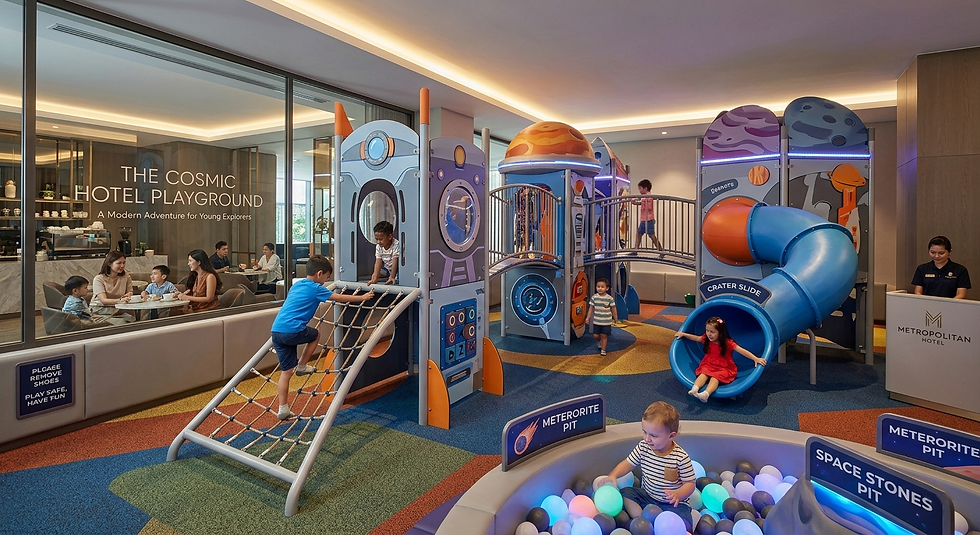
Space & Cosmic World: A high-tech, futuristic aesthetic that appeals to older children and fits perfectly in modern, urban family centers.
Color Bubble & Lollipop: High-energy, whimsical designs that work wonders in malls or dessert-focused cafes, creating a "candy-land" reality.
Town: A role-play focused theme where children can pretend to be shopkeepers, doctors, or drivers. This keeps children engaged for hours through social play.
Customization and Modern Engineering
A customized playground solves the "footprint problem." Whether you have a small corner in a cafe or a massive atrium in a resort, modern engineering allows for vertical play. Multi-level structures, soft-play barriers, and interactive digital elements (like projection floors) ensure that you maximize "Play-per-Square-Meter."
4. Where is the ROI: The Math of Play
Investing in a playground is a capital expenditure that pays for itself through Return on Dwell Time (RODT).
The Dwell Time Multiplier
Let's look at a typical restaurant scenario:
Metric | Without Playground | With Customized Playground |
Average Dwell Time | 45 Minutes | 90–120 Minutes |
Average Check (Family of 4) | $80.00 | $125.00 |
Repeat Visit Frequency | 1.2x per year | 4.5x per year |
Customer Lifetime Value | Low | High |
The "Parental Peace" Premium
When parents feel their children are safe and happy, they are less price-sensitive. They perceive the "value" of the outing not just by the quality of the meal, but by the lack of stress. This allows venues to maintain higher margins because they are providing a comprehensive "family solution."
The Marketing "Selfie-Point"
A beautifully designed Lollipop or Jungle theme is inherently "Instagrammable." Every photo a parent posts of their child laughing in your playground is a high-trust, $0-cost advertisement. This "Organic Reach" reduces your traditional marketing spend significantly.
5. Who is it Suitable For?
Customized indoor playgrounds are the "Secret Growth Weapon" for:
Hotels and Resorts: To increase "Family Occupancy" during off-peak seasons and drive internal spend at hotel bars and restaurants.
Casual Dining & Gastropubs: To capture the massive "Weekend Brunch" and "Early Dinner" family markets.
Shopping Centers & Malls: To transform a retail trip into an "Experience Destination," increasing the time spent in the building.
Family Entertainment Centers (FECs): Where the playground is the primary product, requiring the highest level of playground themes to stay competitive.
Fitness Centers & Spas: Allowing parents to commit to memberships because their childcare needs are integrated into their wellness routine.
6. What Mistakes Do Buyers Make?
To ensure your investment delivers the expected ROI, you must avoid these common pitfalls:
1. Prioritizing Price over Certification
Buying uncertified equipment from low-cost overseas marketplaces is a legal and safety timebomb. Commercial-grade playgrounds must meet rigorous safety standards (like EN 1176/1177). A single injury due to poor quality can result in litigation that far outweighs any initial savings.
2. Ignoring the "Age-Gap" Problem
Many buyers install a "one-size-fits-all" playground. If the equipment is too difficult for a toddler or too boring for an 8-year-old, you lose half your demographic. A modern playground should have dedicated zones: a soft sensory area for ages 0–3 and more challenging climbing structures for ages 4–10.
3. The "Bland Box" Design
Installing a generic, primary-color playground is a missed opportunity. In 2026, aesthetics matter. If the playground looks like a "cheap plastic cage," it won't attract premium clients. It needs to be a customized modern space that parents want to be seen in.
4. Forgetting Maintenance and Hygiene
An indoor playground that is hard to clean becomes a "germ-center" that drives families away. High-quality designs use materials that are easy to sanitize and have "maintenance-friendly" access points.
7. Transform Your Venue into a Family Destination
The question is no longer whether you can afford to install an indoor playground; it's whether you can afford to let your competitors own the family market. A customized indoor playground is the ultimate anchor for business growth. It turns "restless energy" into "revenue growth" and "boredom" into "brand loyalty."
Ready to Design Your Revenue Engine?
Whether you envision a sprawling Cosmic World, a whimsical Lollipop Town, or a rugged Safari Adventure, our team is ready to engineer a solution that fits your space, your brand, and your budget.
Our Process:
Strategic Consultation: We analyze your demographic and revenue goals.
Bespoke 3D Design: See your chosen theme (Jungle, Pirates, Space, etc.) in your actual floor plan.
Precision Installation: Certified, durable, and built for high-traffic environments.
Contact us today to receive our 2026 Catalog of Modern Playgrounds.
✉️ Email: richard@reatek.eu
📞 Phone: +421 905 671 158
🌐 Web: www.reatek.eu
Don't just build a playground. Build a business that families never want to leave.


Comments